
A common feature in county lines drug supply is the exploitation of young and vulnerable people. The dealers will frequently target children and adults – often with mental health or addiction problems – to act as drug runners or move cash so they can stay under the radar of law enforcement. (National Crime Agency, n.d.)
In recent years county lines have become a notable feature of discussions on drug crime in the UK. It shapes policy, it informs police strategy, makes headlines, and is fast becoming a staple of the popular cultural narrative on contemporary drug crime.
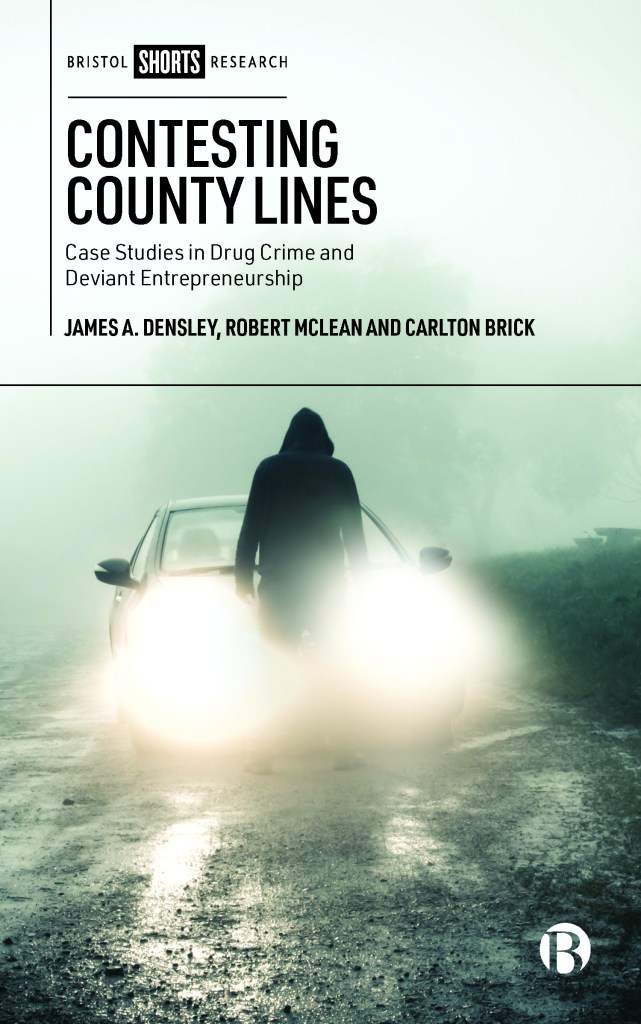
In February I was invited on to the Shaun Atwood Unleashed podcast to discuss my latest co-authored book Contesting County Lines: Case Studies in Drug Crime & Deviant Entrepreneurship, published by Bristol University Press in 2023. During the interview I was asked the question how are county lines drug networks changing to avoid the law? This is an interesting question because in fact it appears that the opposite is happening – that the law is doing its utmost to not deal with drug offences as criminal acts, but as medicalised psychological problems.
The jargon of county lines – because that’s what it is, a jargon that is often used to describe what is in fact quite simply, ordinary and ‘old fashioned’ drug dealing – is being used as a vehicle through which the policing and prosecution of drug related crime are redefined. Traditional liberal concepts, such as guilt, innocence and criminal culpability are being undermined as the criminal justice system is encouraged to become much more therapeutic in their approach to drug related crimes. What follows is an expansion on my answer to the question posed during the podcast which draws upon material discussed in Contesting County Lines .
So, what is a county line? In short, a county line is a term used to characterise the relocation of organised drug dealing, from saturated urban markets, to new more peripheral, rural settings. The classic model is the seaside, costal town. The argument is that through coercion and exploitation of vulnerable people, and young children – who are used to transport drugs to these new rural sites via public transport – urban gangs are able to expand their influence and create new markets. Drug activity that was once localised and largely unorganised are replaced by new, complex networks of organised trade, that often use the threat of violence. Such is the extent of this phenomenon that in 2019 the National Crime Agency declared county lines a ‘significant national threat’ (National Crime Agency. NCA 2019 cited by Harding 2020:13).
So, the story goes, county lines challenge the standard or traditional ways in which drug activity is policed and prosecuted. Policing, if it is to deal with this new threat has to adapt and adopt to these new shifts in the organisation and methodological rationales in drug supply in the UK. Increasingly the concept of vulnerability is used to advocate new approaches to policing and prosecuting so called county lines activity. The argument is that traditional approaches to policing, predicated upon a normative understanding of deviance, criminal behaviour and the victim-perpetrator binary, for example, are no longer fit for purpose.
Indeed, one cannot help but feel that the policing of so called ‘vulnerable populations’ has attained far greater priority within law enforcement policy than either the dealing or consumption of controlled substances themselves.
Instead, notions of structural vulnerability and vulnerable populations are put forward as ways in which to understand these new drugs markets, advocating a more therapeutically informed approach to policing. It is the purpose of this essay to locate these developments within broader sociological concerns regarding, on the one hand, the historical tendency towards the medicalisation of social issues, and, on the other, the co-option of psychological concepts, such as ‘vulnerability’, into non-clinical contexts like criminal justice and policing.
County Lines and the Pathologisation of the Everyday
Although vulnerable groups have always played a role in drug markets that have ‘long been characterised by unequal or exploitative relationships’ (Moyle, 2019: 741), policy-informed definitions of the county lines model pay great heed to the apparent ‘systematic targeting and harnessing of vulnerable populations’ (Windle, Moyle and Coomber, 2020: 67) (original italics). Not only has vulnerability become a central feature in official policy discussion on county lines but also draws attention to wider weakness within law enforcement and the criminal justice system in the UK caused by ‘the limitations of traditional police thinking and practice’ (Coliandris, 2015: 25).
Indeed, one cannot help but feel that the policing of so called ‘vulnerable populations’ has attained far greater priority within law enforcement policy than either the dealing or consumption of controlled substances themselves. In 2017, for example, the Crown Prosecution Service (CPS, 2017) defined county lines as a form of human trafficking, and as such drug dealing could now be prosecuted under the 2015 Modern Slavery Act (2015). In 2018 the first successful county lines convictions were made when the 2015 Act was used to prosecute dealers for child trafficking violations (Windle, et al., 2020).
Police briefings and policy guidance now summarily suggest that language such as ‘drug running’, or ‘drug dealer’ are no longer advisable and be replaced by the terms such as ‘child criminal exploitation’ to reflect the ways in which drugs gangs target vulnerable populations and young people (Windle, et al., 2020).
This adoption of a more therapeutically informed approach to policing drug-related crime reflects broader trends in law enforcement at both national and international levels (Nolan 1998, Fitzpatrick, 2001). This tendency was first identified by sociological perspectives that emerged in the late 1960s and 1970s which began to critically analyse the extension of medicalised forms of knowledge and expertise into non-medical aspects of everyday life (Conrad, 1992, 2005, 2007). Sociology began to adopt a critical stance towards the array of non-medical phenomenon and behaviours that were now subject to the authority of the medical expert. Crucially, critical approaches to this societal expansion of the ‘medical gaze’ theorised it as a form of social control (Parsons, 1951) and surveillance (Foucault, 1965).
Early critics of this trend also outlined how this tendency involved a substantive recasting of the ways in which institutional authority would mediate its relationship with wider society. Irving Zola (1972) noted that the medicalisation of everyday life legitimated the normalisation of the status of patient as the dominant expression of the relationship between institutional power and individuals in society.
The contemporary drive to medicalisation, has two features that distinguish it from earlier forms. First, it is underpinned by the emergence of much more culturally pervasive therapeutic sensibility which has much more psychologised character, whereby diagnosed emotional or psychological problems become the vocabulary through which contemporary social experience is understood. The second, that the contemporary medicalisation of social life is no longer regarded negatively but is welcomed as a way of dealing with social problems more empathetically (Furedi, 2008).
Haslam (2016) points to the process of ‘concept creep’. This is a social process whereby formerly clinically bound psychological concepts become much more culturally pervasive and begin to confer meaning on a range of behaviours and social phenomenon traditionally out with the diagnostic purview of psychology (Haslam, 2016; Haslam and McGrath, 2020). Via concept creep, psychological terms of reference and diagnostic concepts undergo significant ‘semantic change’, cultural expansion and redefinition. Haslam argues that this process has been systematic in the way that it has ‘targeted a particular type of concept’ (Haslam, 2016: 2). In particular, he suggests, it ‘targets’ those concepts that have specific negative salience and accentuate pathological or undesirable aspects of human experience and behaviour. Haslam and McGrath (2020: 514) argue ‘that harm is the thematic drawstring’ that shapes the cultural expansion of these otherwise psychologised concepts.
Police briefings and policy guidance now summarily suggest that language such as ‘drug running’, or ‘drug dealer’ are no longer advisable and be replaced by the terms such as ‘child criminal exploitation’
As a consequence, the concept losses its clinical specificity and is expanded to apply to an ‘enlarged range of additional phenomena’ (Haslam, 2016: 2). Consequently, clinical or diagnostic definitions become much broader and subjective in application and interpretation. Furedi (2008) calls this process ‘diagnosis expansion’ and emphasises the de-professionalised character of the process, as non-medical forms of authority and expertise utilise therapeutic/medicalised concepts as a form of explanation.) He adds that this tendency of to ‘expand the boundaries of trauma’ is a ‘powerful dynamic towards a reconstitution of personhood’ and ‘exemplifies the cultural salience of concept creep’ (Furedi, 2008: 34).
Therapeutic concept creep has become a defining characteristic of the narratives on UK county lines and drug crime and vulnerability has been normalised as a means of reframing the victim perpetrator binary. Both Policy and scholarship appropriate increasingly therapeutic frameworks of understanding to problematise orthodox liberal conceptualisations of personhood, autonomy and agency. The valorisation of psychologised forms of understanding within approaches to county lines reconstitutes the norms, values and competencies of the legal and criminal justice system that are charged with dealing with the issue.
Therapeutic Jurisprudence’s Problem with Binary Norms
Traditional approaches to law and order have largely been supplanted by a psychological nomenclature where behaviours once commonly understood as criminal are recast as pathologies or forms of psychic harm.
This is true of drug crime which has shifted from a correctional context into a more clinical setting. As distinctions between criminal and therapeutic become blurred the authority of more traditional, binary approaches to criminal justice are problematised.
Recent criminological scholarship on illicit drug markets and county lines in the UK, echo this anti-binary trend, questioning the integrity of the prevailing value systems that inform policing and policy strategies. Current scholarship on county lines suggests that the binary thinking that informs police practice—predicated upon ‘idealised’ understandings of vulnerability and normative notions of victimhood—hinders the safeguarding of those exploited by county lines gangs and exacerbates the vulnerability of those it purports to be trying to help (Windle, et al., 2020). A key feature of this argument is the proposition that the distinction between victim and perpetrator is no longer tenable. Scholars suggest that the criminal justice services misinterpret involvement in drug dealing as an expression of rational choice on the part of the participant. Munro and Scoular (2012) refer to this as a ‘politics of vulnerability’, that define who and ‘who is not recognised to be vulnerable, and in what conditions’ (Moyle, 2019: 742).
The Politics of Vulnerability: County Lines and Concept Creep
The tendency towards medicalisation has attained a very different significance within contemporary everyday life and experience. As Furedi (2008: 102) has noted, ‘Since the 1980s, opposition to medicalisation has been minimal’. Perspectives that would have positioned themselves in opposition to the medicalisation tendency now appear to see it as a potentially liberating, and empowering development. This has meant that the process has lost its overtly medicalised character. For example, in the case of the county lines discussion, clinical terms are now often used by criminologists to describe drug-related policing.
The fore-fronting of vulnerability as a driver of institutional change, suggests an expansion of the range and forms of behaviour and social activity previously considered well beyond the purview of policing systems
This apparent therapeutic turn in contemporary criminology accentuates the inadequacy of traditional criminal justice approaches and demands fundamental culture change within police practice. For Coliandris (2015 : 34), county lines bring into sharp focus ‘the interconnected-issues of vulnerability and safeguarding’ as potential points of structural reorientation around ‘questions about the proper roles and responsibilities of police services in democratic societies’. Key to redefining policing culture is ‘a recognition by practitioners that vulnerability is a universal human trait and a process; as such, it is best understood by reference to the complex and dynamic interplay of personal, family, culture and social conditions’ (Coliandris, 2015: 34).
The fore-fronting of vulnerability as a driver of institutional change, suggests an expansion of the range and forms of behaviour and social activity previously considered well beyond the purview of policing systems. This seems borne out by current government agency advice on how to identify county lines activity. On their website, the National Crime Agency (n.d.) provide a list of activities, or behaviours that can be used by members of the public to understand ‘if county lines drug dealing is happing in your area’. Things the NCA ask local residents to watch out for include:
- An increase in visitors and cars to a house or flat;
- New faces appearing at the house or flat;
- New and regularly changing residents (e.g., different accents compared to local accent);
- Change in resident’s mood and/or demeanour (e.g., secretive/ withdrawn/ aggressive/ emotional);
- Substance misuse and/or drug paraphernalia;
- Changes in the way young people you might know dress;
- Unexplained, sometimes unaffordable new things (e.g., clothes, jewellery, cars etc.);
- Residents or young people you know going missing, maybe for long periods of time;
- Young people seen in different cars/taxis driven by unknown adults;
- Young people seeming unfamiliar with your community or where they are;
- Truancy, exclusion, disengagement from school;
- An increase in anti-social behaviour in the community;
- Unexplained injuries.
If, however, one remains unsure that the brand-new top-of-the-range smart phone that the new next-door neighbours surly untalkative teenager has just acquired is proof a county lines network operating in the area, the NCA (n.d.) suggests that ‘The best advice is to trust your instincts. Even if someone isn’t involved in county lines drug dealing, they may be being exploited in some other way, so it’s always worth speaking out’.
Structural Vulnerability and Criminal Autonomy
Reflecting a ‘radically pessimistic account of the workings of human subjectivity and personhood’ (Furedi, 2016: 34), the contemporary valorisation of vulnerability serves as the basis through which forms of social power re-legitimates its relationship with wider society. Vulnerable subjects can only be protected and enabled by state and par-statal forms of therapeutic intervention. This seems an apposite conceptualisation of the outlook that has begun to shape policy and expert knowledge on county lines.
For example, Coliandris (2015: 27) suggests that the ‘precise contours and factors underpinning vulnerability’ need to be understood by agencies because a failure to do so will lead to further harm. For example, NCA (2019) guidance suggests ‘that children who are not known to services and who have no previous convictions are also utilised in County Lines … this means not being part of an organisationally recognised vulnerable group can mean that signs of exploitation can go undetected.’ This view suggests that traditional binary conceptualisations of perpetrator and victim fail to recognise the complexity of the relations of risk, harm and exploitation that inform contemporary drug dealing practice. This view argues that a normative approach to vulnerability is a central weakness in combatting county lines, and policing more widely.
As a consequence, ‘structural’ understanding of vulnerability are now used to challenge the outdated systemically binary character of policing practice. Through reflection upon and recognition of the structural nature of privileged hierarchies of vulnerability criminal justice institutions are now able, so the argument goes, to identify ‘hidden’ unintentional biases that reinforce forms of exclusion, and stigma.
‘Structural vulnerabilty’ also allows criminology to overcome a second problem – that so called vulnerable populations involved in county lines or criminal activity more generally don’t necessarily see themselves or identify as being vulnerable or at risk. Coliandris (2015: 31) argues that orthodox approaches to the labelling of particular behaviours or populations as ‘vulnerable’ are often ‘rejected by the vulnerable person’ themselves as ‘There may be stigmatising and disempowering consequences associated with being labelled ‘vulnerable’, which ‘can adversely impact wider police-specific community relations as well as the individual’s sense of identity, value and autonomy.’ The point regarding autonomy is well made.
Moyle (2019: 750) draws attention to the fact that ‘contrary to police literature’, research in this area suggests, ‘there were as many cases where local drug users described a willingness to undertake this labour, despite numerous associated risks’ (original italics). Moreover, this ‘willingness’ is seen as an integral aspect of the ways in which individuals negotiate their access to illicit drugs. The author continues, ‘for those in the midst of chaotic drug careers, without the resources to otherwise pay for their drug use, the county lines economy provided a ‘mutually beneficial’ labour opportunity, albeit one that appears inherently exploitative for swift and reliable access to drugs’ (Moyle, 2019: 750).
Windle et al. (2020: 71) suggest that, ‘While law enforcement narratives portray county lines as inherently exploitative, adult cuckooed residents reported to Moyle (2019) that they initially considered renting arrangements and drug running a “mutually beneficial relationship”’. Moreover, the authors continue that ‘many vulnerable young people’ interviewed in the research ‘did not necessarily see themselves as victims’ (Windle et al 2020: 71). Ellis (2018) has noted that young people who are generally considered as vulnerable or at risk by institutional authority tend to reject the label as it undermines the more positive and proactive perception they have of themselves.
The concept of ‘structural vulnerability’, blurs the relationship between criminal justice practice and ideas of culpability, responsibility, and agency and provides a rationale for more therapeutic forms of state intervention that move outside the traditional rights-based criminal justice framework. Within contemporary criminology there is an unquestioned (but nonetheless problematic) assertion that the ‘victim’ (the ‘traditional’ offender) lacks the capacity to make decisions that are properly their own or in their own interest. The notion that participation in county lines markets may be the result of choices made by willing individuals is dismissed with the premise that it is irresponsible to expect ‘structurally vulnerable’ populations to ‘behave responsibly’ in the face of disadvantage (Moyle, 2019: 751).
‘Structural vulnerability’ and the idea of ‘structurally vulnerable’ populations negates ideas of agency, judgment and responsibility. It serves as a means by which law enforcement is re-legitimated as a therapeutic enterprise. The criminal justice approach to drug crime is subordinated to an institutionalised therapeutic world view, and the culturally expansive pathologizing tendencies identified by concept creep.
Concluding Remarks
As Furedi (2016) notes, the concept of vulnerability has become so culturally engrained it often goes without critical comment or questioning. So, it is within criminology. There appears an increasing reluctance within policy and practice circles to critically engage with the marked psychologisation of the conceptual framework which is now used to define county lines and related illicit drug-related behaviours.
The therapeutic character of county lines narratives represents a fundamental reconstitution of criminal justice and law enforcement in the UK. Attempts to normalise ideas of subjective vulnerability, and the undermining of liberal juridical assumptions of individual agency, seem to be readily accepted by policy makers and proponents of a therapeutically-informed criminology. Might this not be the real source of the drug problem in the UK?
References
Coliandris, G. (2015). County lines and wicked problems: Exploring the need for improved policing approaches to vulnerability and early intervention. Australian Policing, 7 (2), 25-35.
Conrad, P. (1992). Medicalisation and social control. Annual Review of Sociology, 18, 209-232.
Conrad, P.(2005). The shifting engines of medicalisation. Journal of Health and Social Behaviours, 46 (1), 3-14
Conrad, P., (2007). The medicalisation of society. John Hopkins University Press.
Fitzpatrick, M. (2001). The tyranny of health. Routledge.
Foucault, M., (1965). Madness and civilisation. Pantheon Books.
Furedi, F. (2021). Why borders matter. Routledge.
Furedi, F. (2016). The cultural underpinning of concept creep. Psychological Inquiry, 27(1), 34–39.
Furedi, F., (2008). Medicalisation in a therapy culture. In D. Wainwright (ed.). A sociology of health (pp. 97-114). Sage.
Harding, S. (2020). County lines: Bristol University Press.
Haslam, N. (2016). Concept creep: Psychology’s expanding concepts of harm and pathology. Psychological Inquiry, 27(1), 1-17.
Haslam, N & McGrath, M. J. (2020). The creeping concept of trauma. Social Research, 87(3), 509-531.
Munro, V. E., & Scoular, J. (2012). Abusing vulnerability? Contemporary law and policy responses to sex work in the UK. Feminist Legal Studies, 20, 189-206.
Moyle, L. (2019). Situating vulnerability and exploitation in street-level drug markets: Cuckooing, commuting, and the ‘county lines’ drug supply model.’ Journal of Drug Issues, 49(4), 739-755.
National Crime Agency (n.d.) What we do. drug trafficking. county lines [online]. Available at: https://www.nationalcrimeagency.gov.uk/what-we-do/crime-threats/drug-trafficking/county-lines.
National Crime Agency (2019). National intelligence assessment. county lines drug supply, vulnerability and harm. National Crime Agency.
Nolan, J. L. (1998). The therapeutic state. NYU Press.
Parson, T. (1951) The social system. The Free Press.
Windle, J., Moyle, L., & Coomber, R., (2020). ‘Vulnerable’ kids going country: Children and young people’s involvement in county lines drug dealing’. Youth Justice, 20(1-2), 64-78.
Zola, I. K. (1972). Medicine as an institution of social control. Sociological Review, 20 (4) 487-504.
 cjbrick